Xinjiang Uygur Autonomous Region Regulations on Guarding State Secrets
By Uyghur Freedom Institute March 4, 2026
URUMQI / WASHINGTON — Xinjiang authorities have enacted a sweeping new regional law on state secrecy, set to take effect on March 1, 2026, that human rights observers warn is specifically designed to suppress information about the ongoing persecution of Uyghurs and other Turkic Muslim minorities in the region.
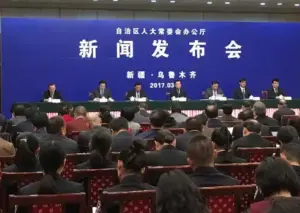
The Xinjiang Uyghur Autonomous Region Regulation on Keeping State Secrets (新疆维吾尔自治区保守国家秘密条例), passed on November 26, 2025 by the Standing Committee of the 14th Regional People’s Congress, goes far beyond China’s existing national secrecy framework — raising urgent questions about why Xinjiang required its own separate law at all.
A Law Within a Law: Why Xinjiang?
China already has a national state secrets law and implementing regulations applicable across all provinces and regions. Legal analysts and human rights advocates say the enactment of a separate, regionally-specific secrecy regulation for Xinjiang is itself significant — and deeply troubling.
“China has a state secret law. But Xinjiang authorities had to enact a new one to hide its crimes against humanity. The new law provides new enforcement mechanisms, including travel restrictions for officials and state secret offices at local institutions.”
— Yalkun Uluyol, China Researcher, Human Rights Watch (@hrw)
The law explicitly states in Article 1 that its purpose includes “maintaining social stability and long-term security in Xinjiang” — language that has long been used by Chinese authorities to justify mass detention, surveillance, and the destruction of Uyghur cultural and religious life.
Key Provisions With Human Rights Implications
1. Sweeping Secrecy Mandates Reaching Down to Villages
Article 5 requires township-level governments and neighborhood committees — the lowest rungs of China’s administrative system — to designate personnel responsible for secrecy management, conduct secrecy education, and “guide grassroots mass autonomous organizations” in secrecy work.
This effectively embeds the secrecy apparatus into the very community structures that are already used to monitor Uyghur families. Village committees and neighborhood watch groups, which in Xinjiang have been documented as instruments of surveillance, are now formally required to participate in suppressing information.
2. AI and New Technologies Weaponized for Secrecy
Article 10 calls for the application of “new encryption technologies, big data, and artificial intelligence” to the secrecy domain. Article 21 prohibits government workers from using AI products to store, process, or transmit state secrets — but more critically, Article 22 requires agencies to integrate AI-based “self-monitoring” secrecy facilities into all information systems.
Human rights groups have long documented China’s use of AI-powered surveillance tools in Xinjiang. This law now formally institutionalizes AI as a tool for enforcing information blackouts — not merely surveilling the population, but controlling what information can ever leave the system.
3. Travel Restrictions on Officials Who Know Too Much
Article 32 imposes a formal demystification period (脱密期) on personnel who leave positions with access to classified information. During this period, such individuals are prohibited from traveling abroad or emigrating and cannot disclose information in any form.
This provision is particularly significant: it effectively traps Xinjiang officials — including those who may have witnessed or participated in abuses at detention facilities, “vocational training centers,” or forced labor programs — inside China. They cannot speak to foreign journalists, human rights investigators, or foreign governments without facing criminal prosecution.
4. Silencing Whistleblowers Through Fear
While Article 36 formally establishes a hotline for citizens to report suspected secrecy violations, the same article — read alongside Articles 34 and 41 — creates a chilling effect. Any person who speaks to the media, a foreign NGO, or a foreign government about conditions in Xinjiang could themselves be reported as a secrecy violator.
Former detainees who have spoken publicly about conditions inside Xinjiang’s camps are, under this legal framework, potentially subject to prosecution for revealing “state secrets.”
5. Border Secrecy Enforcement
Article 29 mandates that the Xinjiang government, together with military and border control authorities, build a comprehensive border secrecy control system combining “human defense, physical defense, and technical defense.” Customs, immigration, and security agencies are required to coordinate in enforcing secrecy at the border.
This provision formalizes what journalists and human rights workers have long reported: systematic searches of phones, laptops, and personal devices at Xinjiang’s borders, and the interception of information flowing out of the region.
6. Classifying Aggregated Information
Article 24 is particularly far-reaching: it requires agencies to treat aggregated data — information that may not individually constitute a state secret but collectively does — as classified. This means that even benign administrative records about Uyghur communities, when combined, could be designated as secret and shielded from disclosure.
This provision could be used to block researchers, journalists, and UN investigators from accessing demographic data, birth rate statistics, religious practice records, and other information that has been central to documenting the campaign against Uyghurs.
7. Criminalizing Media and Online Reporting
Article 39 explicitly lists as a reportable security threat any situation where “public media including books, periodicals, radio, film, television, or online publications, streaming programs, or self-media” publish or broadcast classified information.
Given that Chinese authorities have in the past designated information about detention facilities, population transfers, and birth control campaigns as state secrets, this provision creates a legal mechanism to prosecute domestic journalists and citizen reporters who attempt to document conditions in Xinjiang.
Context: A Region Under Documented Repression
The United Nations, in its 2022 assessment, found that China’s treatment of Uyghurs and other Turkic Muslims in Xinjiang may constitute crimes against humanity, including arbitrary detention, torture, forced labor, and the suppression of religious and cultural identity. China rejected those findings.
Since then, access to Xinjiang for independent journalists, UN investigators, and foreign diplomats has remained severely restricted. The new secrecy law, critics say, is designed to make that information lockdown permanent and legally enforceable.
International Response
As of publication, the United States, European Union, and United Kingdom have not issued formal statements specifically addressing the new Xinjiang secrecy regulation. Human rights organizations are urging governments to raise the law at the UN Human Rights Council and to sanction officials responsible for its implementation.
What Comes Next
The law took effect on March 1, 2026. Enforcement mechanisms — including the AI-integrated monitoring systems, border controls, and demystification-period travel bans — are expected to be rolled out in the weeks and months that follow.
For Uyghurs inside Xinjiang, and for the diaspora communities seeking to learn the fate of missing relatives, the message from Beijing is clear: what happens in Xinjiang stays in Xinjiang — by law.